
State of Compensation
Main Recommendations
- Increase pay across the board for both the Standard Salary Schedule and the Correctional Officers Salary Schedule, including entry level pay
- Guarantee annual cost-of-living increases that align with the Consumer Price Index (CPI) as well as annual step increases
- Adjust pay for everyone in AFSCME’s bargaining units to account for all missed step increases
Jump to each section:
- The cost of living continues to increase but state employee salaries do not keep up.
- Over 11,200 state employees are missing step increases — compressing wages and hurting morale.
- The starting pay for state jobs in Maryland often pales in comparison to the starting pay in neighboring or comparable jurisdictions.
- The State of Maryland has failed to enact recommendations to address pay equity issues.
The cost of living continues to increase but state employee salaries do not keep up.
70% of respondents disagree or strongly disagree that they are properly compensated for the work they do as state employees.
According to MIT’s Living Wage Calculator, the living wage for two working adults and two children is $30.99 per hour. The starting wage on the standard salary scale for FY 27 is only $18.50 — $12.49 below a living wage.
A 2024 Forbes article ranked Maryland as the 7th most expensive state to live in based on cost of living. The article estimated that $48,235 is needed to cover yearly expenses for housing, healthcare, food, and transportation in Maryland for a single adult, even though the annual starting salary on the state’s standard salary scale is only $38,582.
Inflation has continuously outpaced state employee wage increases. This means that, adjusting for inflation, a state employee makes functionally less in 2026 than they did in 2010.
While working for the State...
85%
Percentage of survey respondents who have struggled to pay off debts.
79%
Percentage of survey respondents who have struggled to pay for necessities
47%
Percentage of survey respondents who have delayed medical care
56%
Percentage of survey respondents who have had to work multiple jobs
87%
Percentage of survey respondents who have had to change spending habits
32%
Percentage of survey respondents who have delayed retirement
What AFSCME Members Are Saying:
“Without consistent step and COLA increases, it makes it difficult to pay bills and everyday living expenses. Costs continue to rise as paychecks remain the same. It's frustrating because a second job may be necessary, but you have to deal with reporting secondary employment which seems unfair. So, to avoid the hassle with HR, multiple job opportunities are taken off the table.”
— Survey Response, Medicare Program Associate, MDH
“I am working 2 jobs, plus doing side hustles to stay afloat. When I am not at the MVA, I'm doing security, when I'm not doing security, I am doing hair, babysitting, doing grocery orders and whatever else I can to live. It's already an expensive state and living is getting more expensive.”
— Survey Response, Customer Agent II, MVA
Over 11,200 state employees are missing step increases — compressing wages and hurting morale.
According to the Maryland State Personnel and Pensions Code § 8-106:
“The regulations adopted under this subtitle shall provide for automatic increases, from minimum to maximum steps in a pay grade, of the pay rates set by the Standard Pay Plan for an employee whose overall performance is rated satisfactory or above on the employee’s annual performance appraisal.”
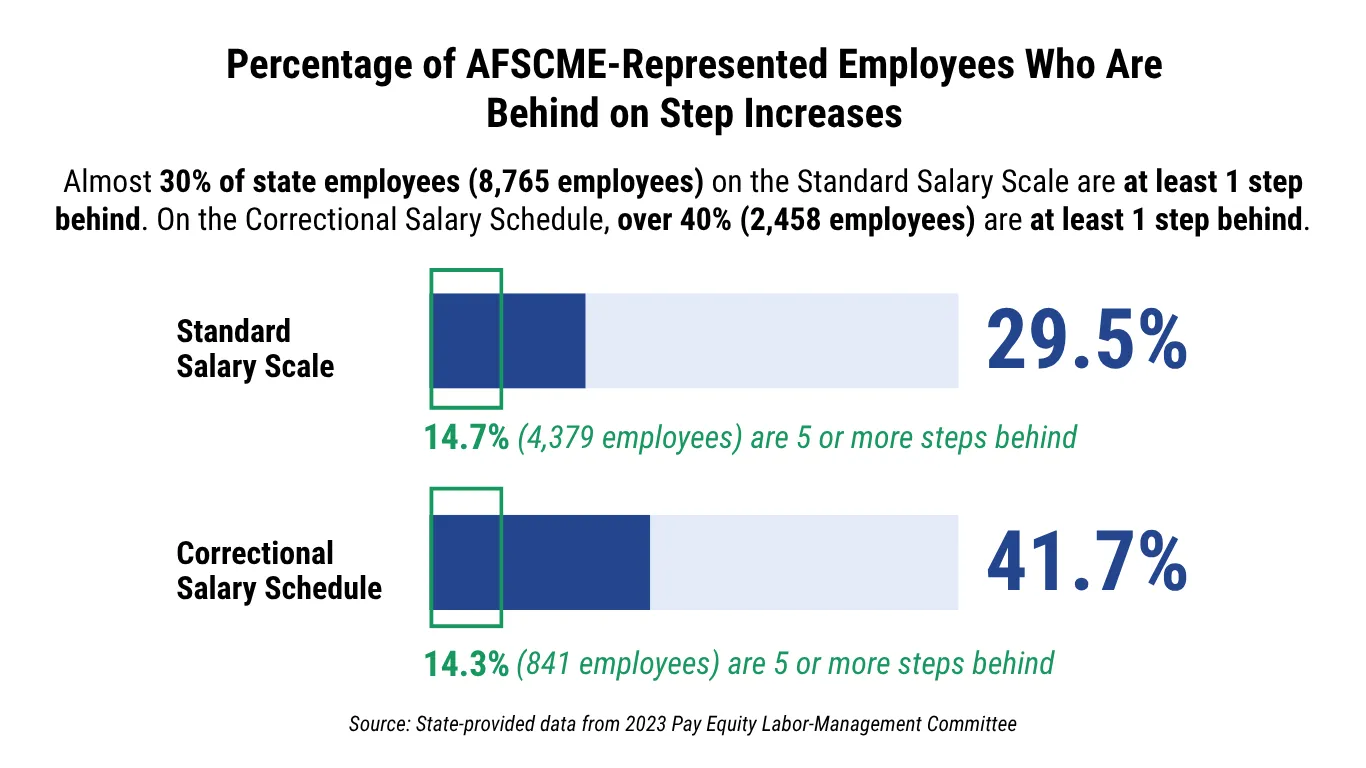
The purpose of an annual step increase is to recognize the growth and contributions of an employee for each year of service they have on the job. Regular step increases are also critical to retain staff, prevent wage compression, and keep wages competitive with the private sector. Instead, in any given year, there is no guarantee that state leaders will choose to fund a step increase, setting state employees even further back.
While the starting pay has increased for more recently hired employees, the pay for those who have more years of service continues to fall behind. This creates wage compression issues as the pay for more experienced employees remains stagnant and makes it incredibly difficult to retain state employees.
In addition, as longer-tenured state employees start to retire, there will be an even greater shortage of experienced individuals, exacerbating the state’s staffing crisis.
According to data provided to AFSCME from the State of Maryland, nearly 1 in 4 correctional officers who work for the State of Maryland could leave state service at any time because they have already qualified for retirement and their pensions. Of the over 5,000 correctional officers who work for the State, we have tracked that almost 1,000 officers are at 20 or more years of service, an additional 160 officers are at 30 or more years of service, and another 148 officers are at over 10 years of service and at least 67 years old.
What AFSCME Members Are Saying:
“I don’t feel properly compensated because my pay hasn’t kept pace with increased workload, responsibilities, and cost of living. We’re asked to do more with fewer resources and meet stricter requirements — but the salary steps and raises haven’t matched that growth. It creates a gap between the value we deliver and what we take home.”
— Survey Response, Developmental Disability Associate, MDH
“I have been an agent for 18 years and stuck it out during the lean times of Governors Hogan, O'Malley, and the current governor. I feel disrespected and unappreciated when agents who have no experience are getting compensated as much or more than me and my colleagues.”
— Survey Response, Parole and Probation Agent, DPP
The starting pay for state jobs in Maryland often pales in comparison to the starting pay in neighboring or comparable jurisdictions.
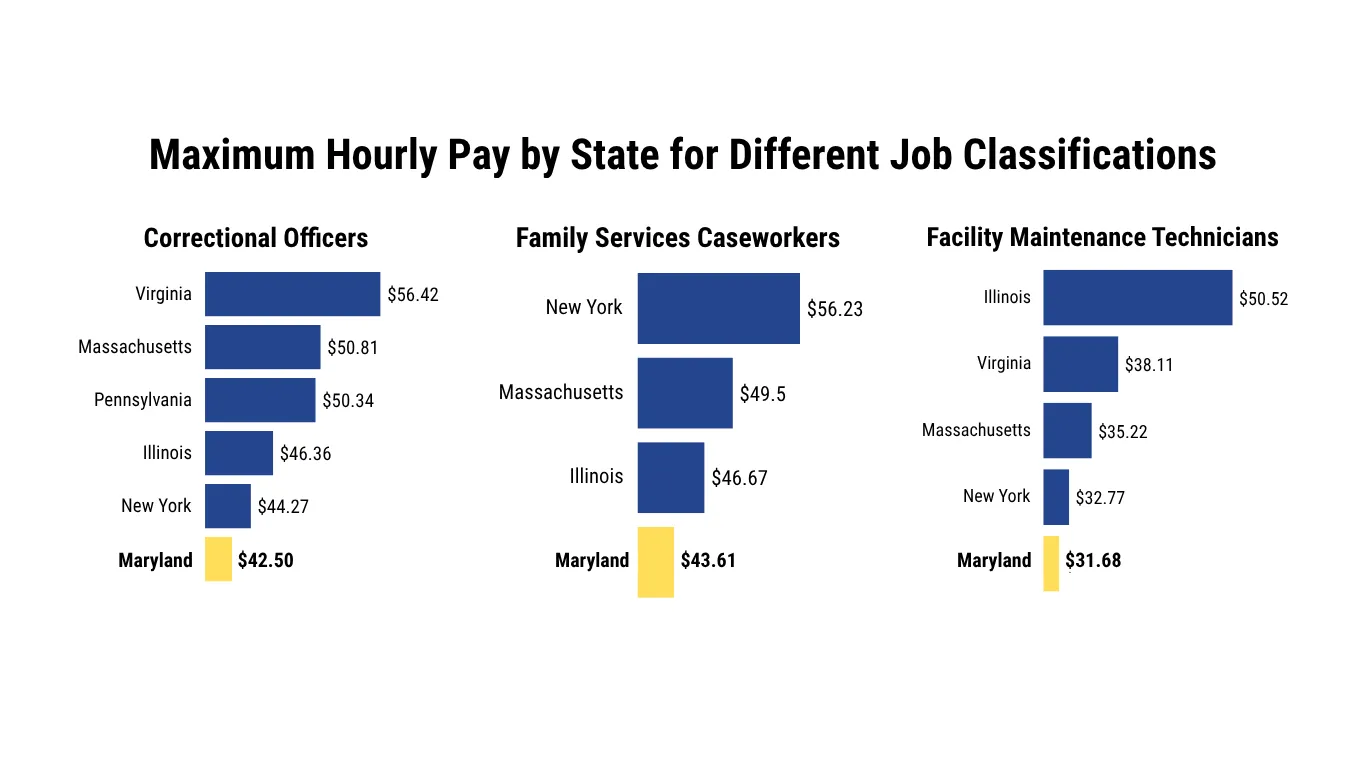
When looking at comparable states to Maryland, the maximum hourly pay for some of the state’s most common job classifications — correctional officers, social workers (Family Services Caseworkers), and highway workers (Facility Maintenance Technicians) — continues to be behind.
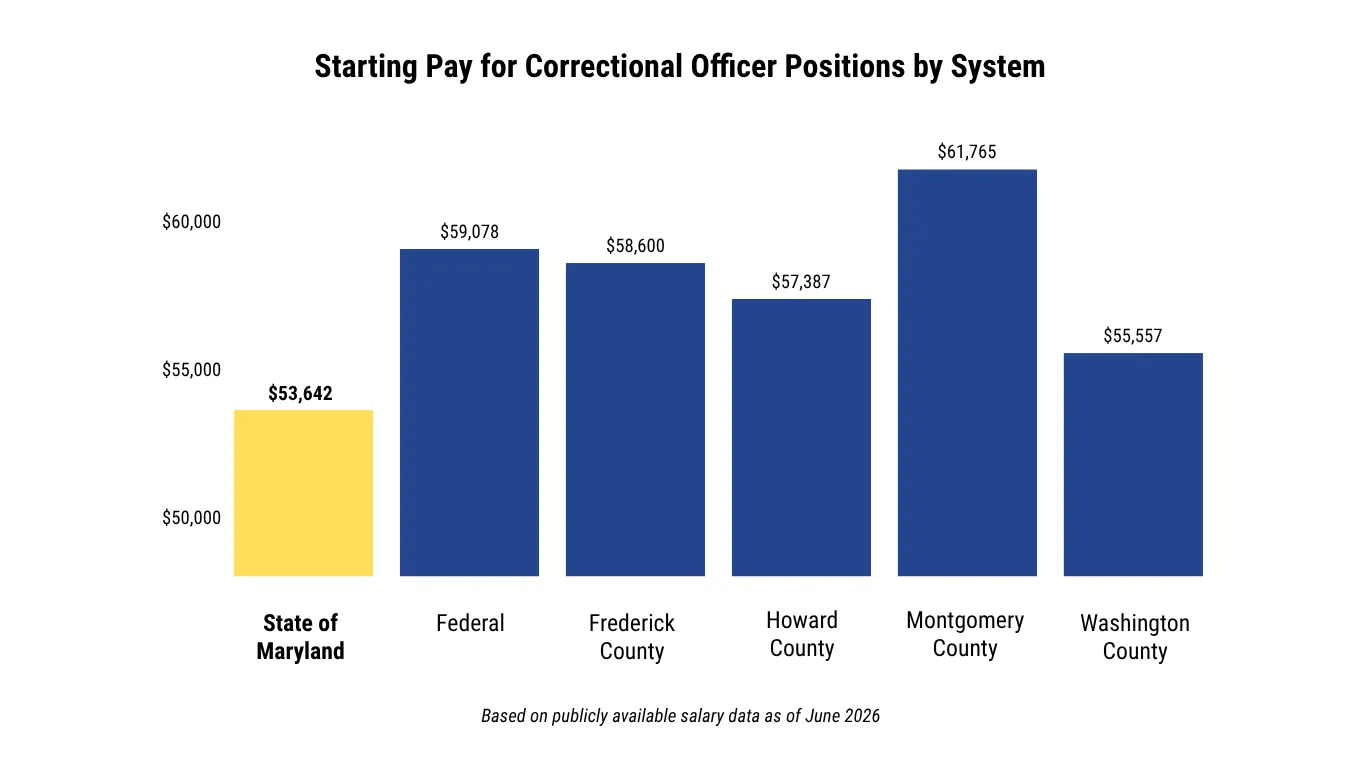
For correctional officers in particular, starting salaries cannot compete with what is offered by the federal prison system and nearby counties.
AFSCME members in the western Maryland state correctional facilities could leave state service at any time and make significantly more pay at a federal prison or county jail, and we are seeing a steady flow of officers leaving state employment to do so.
The State of Maryland has failed to enact recommendations to address pay equity issues.
Article 7, Section 1D (Pay Equity and Salary Competitiveness LMC) of AFSCME’s union contract with the State of Maryland (which runs from January 1, 2024 through December 31, 2026) calls for the establishment of a labor-management committee to “evaluate modifications to the State’s Standard and Correctional Salary Schedules, pay equity, and salary compression... The committee shall explore modifications to the State’s Standard and Correctional Salary Schedules, pay equity and salary compression and shall make recommendations to the Secretary of DBM by August 1, 2024.”
Talks were delayed, but in September 2024, AFSCME Maryland met with State leaders and presented a comprehensive overview of pay issues, including wage compression, missed step increases, lack of competitive salaries, and more.
AFSCME’s presentation ultimately called for the following to address pay equity issues:
- Increase pay across the board for both the Standard Salary Schedule and the Correctional Officers Salary Schedule, including entry level pay
- Establish a consistent 2.5% pay increase between each step
- Guarantee annual cost-of-living increases that align with the Consumer Price Index (CPI) as well as annual step increases
- Adjust everyone’s pay to account for all missed step increases
Our union continued to meet with the State that fall, but to this date, State leaders have failed to enact or address any of our recommendations.